


Forklift attachment lifespan: what affects it and what to do about it
Most businesses fit their forklift attachments and get on with the job, which is exactly as it should be. The problem is that wear can creep up quietly. By the time you realise something is off, you could already be dealing with a safety issue, a compliance problem and an unexpected repair bill.
Under ISO 5057, a fork blade worn by just 10% of its original thickness loses 20% of its safe load-bearing capacity. Once a fork hits that limit, it needs to come out of service. Run one past that point and you’re operating equipment that can’t safely lift what it says on the capacity plate. Most UK insurers won’t pay out on an incident if a LOLER report shows the forks were past the wear limit at the time.
That 10% rule applies specifically to forks, but the same thinking runs across all lifting attachments. Jibs, hooks, skips and platforms all wear with use. None of them should be fitted and forgotten.
What affects how long forklift attachments last?
It’s less about age than you might think. What matters more is what the attachment has been through.
- Intensity of use, not just hours
A three-year-old forklift in a low-volume yard can have forks in near-perfect condition. A six-month-old truck on a 24/7 site might already be getting close to the wear limit. Consider workload over age. - What you’re lifting
Abrasive materials like grit, stone and recycled aggregate act like a sander on fork blades, gradually thinning the metal with every job. For jibs and crane attachments, uneven or off-centre loads put extra stress on weld points and joints. - Where you’re storing them
Attachments left outside on a damp UK yard or used in corrosive conditions will degrade faster than ones kept under cover. Salt, moisture and grit are the main culprits. - Whether anyone’s checking them
Regular inspection is probably the biggest factor in how long an attachment lasts. Catching a small crack or a worn seal early costs very little. Missing it until it becomes a structural problem costs a lot more.
The key signs of wear to look for
Knowing what to look for and where makes all the difference. Here’s what to check.
Fork blade wear (the 10% rule)
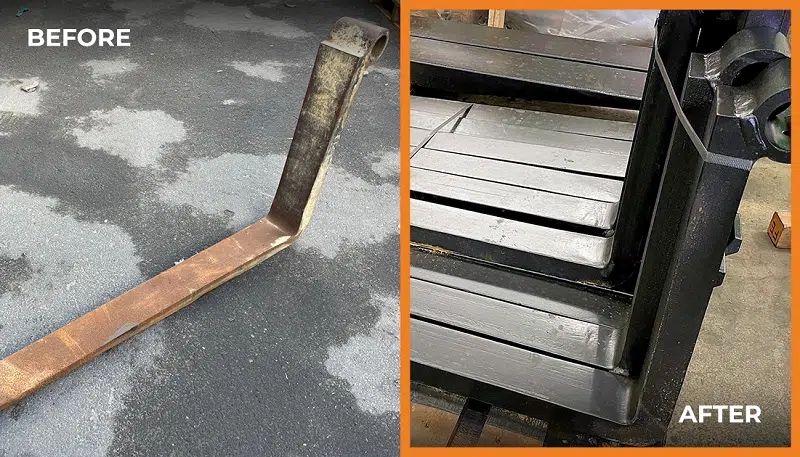
Any fork blade worn to 90% of its original thickness has to come out of service. That 10% loss in steel means a 20% drop in rated lifting capacity. Measure it and if it’s at or below that limit, the fork is scrap. There’s no legal way to fix a blade that’s gone too far.
Tip height difference
Park the truck on level ground and look at the fork tips. If one sits more than 3% of the blade length higher than the other (that’s a 30mm gap on 1,000mm forks), the forks are bent. Bent forks make loads tilt and slide, which is a tipping hazard and a straight fail on inspection.
Cracks and surface damage
Grab a torch and check the heel of the fork closely (the curved bend where the blade meets the shank). It’s the highest-stress point on the attachment. Look for hairline cracks, notching or any fresh damage in the paintwork. A crack in the paint at a stress point can mean there’s a crack in the metal underneath too.
Hook wear and deformity
For carriage-mounted attachments, check the hooks. If they’ve stretched or deformed and the attachment is rattling or sitting unevenly on the carriage, load security is gone. Movement that wasn’t there before is a sign something’s wrong.
Corrosion and structural damage on skips, jibs and platforms
On skips and platforms, look for rust and any bowing in the base plate. If a tipping skip’s safety catch is not engaging, that’s a drop hazard waiting to happen. On jibs, check the lifting eyes. If a circular hole has pulled into an oval shape, the metal has stretched and the attachment needs to come out of service.
A LOLER Thorough Examination is required every six months for most lifting attachments and it’s the most reliable way to pick up things a visual check might miss. For a full breakdown of what’s involved, take a look at our guide to LOLER Thorough Examinations.
Repair or replace: how to decide
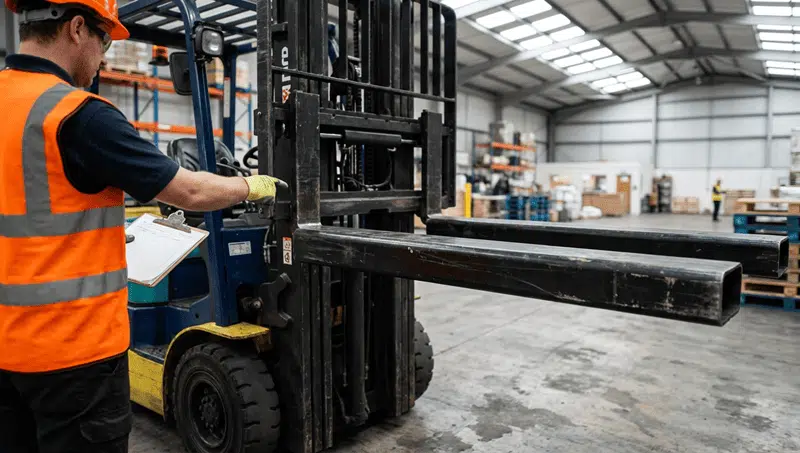
This is where a lot of businesses get stuck. As a general rule: if the core structure is sound, repair is often the right call. If it’s something safety-critical, like blade thickness or a cracked weld, it isn’t.
When refurbishment makes sense
If the metal frame is solid but the working parts are tired, refurbishment is often a smart option. A lot of attachments might just need worn seals, hoses or pins replacing. That could get a unit back to full working condition for a fraction of what a new one costs, with a lot less downtime too.
Peter Sharpe, Managing Director at Invicta:
“A lot of what we see coming in for repair is attachments that have been run too long without maintenance. The steel is usually fine; it’s the moving parts that need attention. Catching it earlier would have been cheaper and faster for everyone.”
When replacement is the only option
Some damage simply can’t be legally fixed. A fork blade at the wear limit is scrap – you can’t weld material back onto a blade to restore its capacity. The same goes for cracked structural welds, bent frames and stretched lifting eyes on jibs.
Sometimes a fork doesn’t just wear, it snaps. Recently, a national forklift dealer came to us after the forks on a customer’s Kalmar DCE 100-6 had snapped clean through, leaving the whole operation at a standstill. Repair wasn’t an option – structurally, there wasn’t anything to save. So we quoted, manufactured and delivered a full replacement set within two weeks.
Trying to patch structural damage yourself is a serious safety breach and a straight fail on your next inspection. If the structure’s compromised, replacement is the only right answer — and the sooner that conversation starts, the sooner the machine is back working.
Find out more about our repairs and refurbishment service
Maintenance habits that extend attachment life

Extending the life of your attachments doesn’t need to be overly complicated. A few straightforward habits go a long way.
Pre-shift visual checks: don’t skip them
Two minutes at the start of a shift can save thousands in repair costs. Operators should be looking for leaking hydraulic seals, loose bolts and any cracking or flaking in the paintwork, which can hide damage in the metal underneath. A small leak or a loose pin spotted today stops a snapped hose or a dropped load tomorrow.
Don’t push overloaded attachments
Keep the 10%/20% rule in mind. If the forks are already thinning, pushing them with a heavy load creates a safety risk and physically stretches the metal past its limit. Once a fork or jib is bent out of shape, don’t try to straighten it yourself. Some forks can be recovered by a professional, but many can’t, and using a bent fork before it’s been checked is a serious risk.
Clean and store properly
Moisture and abrasive grit are the biggest contributors to early wear on UK sites. After working with sand, salt or harsh materials, rinse the attachment down to stop corrosion. When it’s not in use, store it off the ground on a rack or pallet and under cover if you can.
Schedule LOLER Thorough Examinations
For most attachments, a Thorough Examination is required every six months under the Lifting Operations and Lifting Equipment Regulations (LOLER). Schedule them in advance and treat them the same way you would any other planned maintenance.
Keep a record of inspections
A simple log for each attachment, covering the last inspection date, any repairs done and the LOLER certificate date, keeps your fleet easy to manage and gives you a clear paper trail if you ever need it for an audit or an insurance claim.
Not sure whether your attachments need a check, a repair or a replacement? Our team will give you a straight answer. Get in touch or take a look at our repairs and refurbishment page.
Back to all blog posts